


To register a trademark in Colombia, the applicant must select the sign, identify the goods or services it will distinguish, determine the corresponding classes under the International Classification of Goods and Services for the Purposes of the Registration of Marks, conduct a trademark clearance search and file the application with the Colombian Superintendency of Industry and Commerce (SIC). The authority subsequently conducts a formal examination, publishes the application so that third parties may file oppositions and performs a substantive examination before granting or refusing registration.
Registration grants its owner the exclusive right to use the trademark in Colombia in connection with the protected goods or services and constitutes an essential legal instrument for preventing third parties from using or registering confusingly similar signs without authorization.
Steps to register a trademark in Colombia
Before filing a trademark application with the SIC, it is advisable to complete the following steps:
- Select the trademark to be registered
The trademark must enable consumers to identify and distinguish a company’s goods or services from those offered by its competitors. It is advisable to select a distinctive sign that is not exclusively generic, descriptive or customary in relation to the goods or services for which protection is sought.
For example, it would not be possible to obtain exclusive rights over the term “DICLOFENAC” for a pharmaceutical product because it is the generic name of the product.
- Define the goods or services that the trademark will identify
The application must clearly identify the goods or services that will be distinguished by the trademark. This definition is decisive because it determines the scope of protection and makes it possible to identify the classes in which the application must be filed.
- Identify the classes under the Nice Classification
Goods and services are organized into the 45 classes of the International Nice Classification. An initial search may be conducted through TMclass, a tool that allows users to search for terms and identify the classes in which they may be included.
The classification must be selected carefully because an incorrect classification or an insufficient description of the goods and services may adversely affect the scope of the application.
- Conduct a trademark clearance search
Before filing the application, it is advisable to determine whether there are any previously filed or registered trademarks that may create a likelihood of confusion or association. An initial search may be conducted through the SIC Industrial Property System (SIPI).
A professional search should not be limited to identical matches. It should also assess orthographic, phonetic, conceptual and visual similarities, as well as the relationship between the goods or services identified by the relevant signs.
You may request a professional trademark clearance search to identify the principal obstacles and risks before investing in an application.
- Determine the type of trademark
The protection sought should correspond to the manner in which the trademark will be used. The most common categories include word marks, composite marks and figurative marks.
The characteristics of each category are explained in our guide to types of marks.
- Prepare and file the application
The application must include the applicant’s information, a representation or wording of the sign, the list of goods or services to be identified and any additional particulars required according to the type of trademark.
The application may be filed electronically through SIPI. The corresponding official fees must be paid according to the number of classes included in the application.
- Monitor the application
After filing, the applicant must monitor the proceeding, review communications issued by the SIC and respond promptly to any office actions, oppositions or other matters that may arise during prosecution.
Trademark registration process in Colombia
Trademark registration is an administrative proceeding conducted before the Colombian Superintendency of Industry and Commerce. Its principal stages are as follows:
- Filing of the application
- Formal examination
- Publication of the application
- Filing and prosecution of oppositions, when applicable
- Substantive examination
- Decision granting or refusing registration
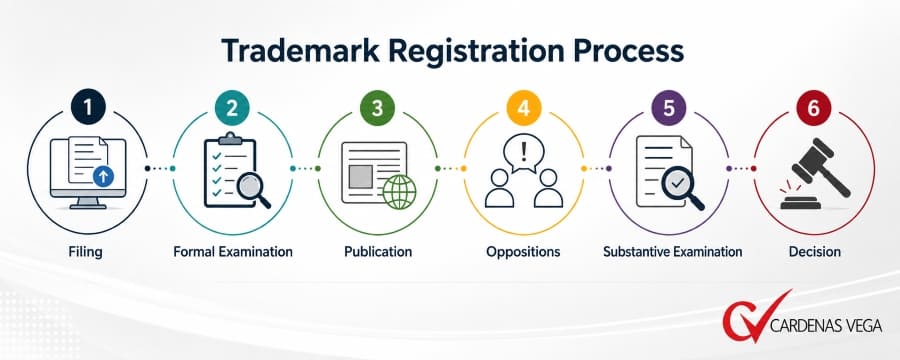
Filing and formal examination
The process begins with the filing of the application and payment of the official fees. The SIC initially verifies that the information and formal elements required for the application to proceed have been submitted.
When an application contains a formal deficiency, the authority may issue an office action requiring the applicant to correct or complete it within the applicable period.
Publication and oppositions
Once the application has passed the formal examination, it is published in the Industrial Property Gazette. Following publication, any party with a legitimate interest may file an opposition within the prescribed period and state the reasons why the trademark should not be registered.
When an opposition is filed, the applicant has an opportunity to respond and submit the arguments and evidence it considers appropriate in support of the trademark’s registrability.
Substantive examination and decision
The SIC determines whether the trademark complies with the applicable legal requirements and whether it is subject to any absolute or relative ground for refusal. At this stage, the authority may consider, among other matters, the distinctiveness of the sign, its potentially descriptive or generic character and the possible existence of a likelihood of confusion or association with prior rights.
Once the substantive examination has been completed, the Colombian Superintendency of Industry and Commerce issues a decision granting or refusing registration of the trademark. This decision may be appealed, thereby requesting that the competent authority review the determination adopted at first instance.
How long does trademark registration take in Colombia?
In practice, a trademark registration proceeding in Colombia may take approximately 10 months to reach a first-instance decision, provided that no circumstances arise that delay the process.
This timeframe is approximate and may vary depending on the workload of the Colombian Superintendency of Industry and Commerce, the complexity of the application and the existence of office actions, oppositions, suspensions, difficulties concerning the classification of goods or services, service or notification issues, or other administrative matters that must be resolved before a decision can be issued.
For this reason, it is advisable to prepare the application correctly, conduct a prior trademark clearance search and respond promptly to any communication issued by the authority.
Term and renewal of a registered trademark
A trademark registration remains valid for 10 years from its registration date. Protection may be renewed indefinitely for successive 10-year periods, provided that the renewal application is filed and the corresponding official fees are paid.
Renewal may be requested during the six months preceding expiration. An additional six-month grace period is also available after expiration, subject to payment of the applicable surcharge.
If the renewal application is not filed within the applicable periods, the registration expires and its owner loses the exclusive rights arising from the trademark.
Cárdenas Vega Asesores maintains monitoring and reminder systems to notify its clients promptly of upcoming trademark renewal deadlines.
International Nice Classification
The International Nice Classification is the system used to organize the goods and services that may be identified by a trademark. It comprises 45 classes: Classes 1 through 34 principally cover goods, while Classes 35 through 45 cover services.
When filing an application, the applicant must specify the goods or services for which protection is sought. The scope of the registration is determined by that description and by the classes included in the application.
Classification should not be analyzed exclusively by reference to class numbers. Two trademarks included in different classes may conflict when their goods or services have a competitive, complementary or commercially significant relationship. Similarly, similar signs may coexist when they identify sufficiently different goods or services and there is no likelihood of confusion or association.
Each additional class included in an application requires payment of the corresponding official fee. It is therefore important to strike an appropriate balance between the necessary legal coverage and the required investment.
You may consult the International Nice Classification in PDF format.
Requirements for filing a trademark application
At a minimum, the following information is required to prepare a trademark application:
- Name or corporate name of the applicant
- Identification or registration number
- Address and contact details
- Wording or graphic representation of the trademark
- Description of the goods or services to be identified
- Corresponding classes under the International Nice Classification
- Proof of payment of the official fees
- Power of attorney, when the application is filed through legal counsel

When Cárdenas Vega Asesores acts as legal representative, the firm provides the corresponding power-of-attorney form. It must be executed by the applicant when the applicant is an individual or by a duly authorized representative when the applicant is a legal entity.
As a general rule, a special power of attorney for prosecuting a trademark application may be executed as a private document and does not require personal appearance, notarization, legalization or an apostille.
How much does it cost to register a trademark in Colombia?
In 2026, the official online fees applicable to a trademark application in Colombia are as follows:
- First or only class: USD 410 (aprox.)
- Each additional class included in the same application: USD 205 (aprox.)
The total amount depends on the number of classes required to protect the relevant goods or services. Professional fees must be added to the official fees when the application is handled by legal counsel.
Official fees are established by the Colombian Superintendency of Industry and Commerce and are adjusted annually.
Importance of conducting a trademark clearance search
Filing an application does not guarantee that the trademark will be registered. Before investing in the process, it is advisable to assess whether any prior rights may prevent registration.
A professional analysis should consider not only identical trademarks, but also signs that are similar from an orthographic, phonetic, conceptual or visual perspective. It should additionally determine whether the relevant goods or services are competitive, complementary, substitutable or marketed through related trade channels.
Based on the results of the trademark clearance search, different strategies may be adopted, including modifying the wording, adjusting the design, narrowing the specification of goods or services, selecting a different class, seeking cancellation of trademarks that constitute an obstacle to registration or abandoning a sign that presents a high risk of refusal.
Why retain a lawyer to register a trademark?
Generally, legal representation is not mandatory for an applicant domiciled in Colombia that files an application directly. Nevertheless, specialized legal advice is recommended because the process involves legal and strategic decisions that may affect both the scope and the likelihood of obtaining registration.
An intellectual property lawyer may provide assistance with matters including:
- Assessment of the trademark’s distinctiveness
- Trademark clearance searches and legal analysis
- Selection of the appropriate classes and drafting of the specification
- Preparation and filing of the application
- Responses to office actions
- Responses to oppositions filed by third parties
- Appeals against adverse decisions
- Post-registration monitoring, watching and renewal
Cárdenas Vega Asesores advises its clients before, during and after the registration process through an initial registrability assessment, prosecution of the application and subsequent management of the trademark portfolio.
Can a lawyer guarantee that a trademark will be registered?
No. No lawyer can legitimately guarantee that a trademark application will be granted. The decision rests exclusively with the Colombian Superintendency of Industry and Commerce and depends on the legal assessment conducted in each individual proceeding.
A lawyer’s professional duty is to act diligently and with the appropriate knowledge and care, rather than to guarantee an outcome that depends on an administrative authority. Even a trademark that initially appears registrable may face oppositions, previously unidentified rights or legal interpretations that result in refusal.
A trademark clearance search and registrability assessment make it possible to estimate risks and adopt an informed strategy, but they cannot entirely eliminate the uncertainty inherent in the process.
Protection after registration
Registration does not eliminate the need to monitor the trademark. The SIC will not necessarily refuse ex officio every subsequent application that may affect the owner’s rights, and it is therefore advisable to maintain a trademark watching service.
Cárdenas Vega Asesores uses technological tools to compare its clients’ trademarks with newly filed applications for distinctive signs and identify potential conflicts. When a potentially harmful application is detected, the owner may consider filing a timely opposition or pursuing another appropriate legal action.
It is also important to monitor renewal deadlines, keep the owner’s information current and periodically confirm that the actual use of the trademark remains consistent with its registration and the company’s commercial requirements.